Leasing season just wasn’t what it’s cracked up to be this year. Q3 data shows that the average DOM ticked up to 26.8 days; although we are leasing properties much more quickly than this industry average if the price is right and we’re not up against the holidays. But what was really discouraging was that even AFTER a price adjustment downward, properties still sat on the market for an average of another 15.4 days. Getting away from the hard data and looking at sentiment, RentEngine surveyed PMs and found that 79% reported a slowdown compared to last year. And you’ll remember, last year wasn’t exactly a banner year for leasing.
Those of you who have worked with us for some time know that we consider DOM (Days on Market) to be one of the most important metrics that we all should be tracking. Property owners and their management need to be making rapid adjustments based on this number. Look at a trailing 30-day trend every single week and make adjustments based on what you’re seeing.
High DOM + Low Leads = Reduce the price ASAP
High DOM + Good Leadflow = Probably a property condition or marketing issue
But I always say, when in doubt, drop the price. Nobody benefits from delaying this. As RentEngine points out in their report, every day of extra time on the market is money lost for both you and your landlord client. Clinging to a price that the market is rejecting is just amateur hour behavior.
The Price is (Not) Right

Let’s dig deeper into price as a factor. According to the report, nearly a full HALF of all properties needed at least one price reduction last quarter. And the average property needed 2.2 price reductions before finally getting leased.
But here’s the most important stat: a listing requiring even a single price reduction added an average of 11 days on market. Let’s say a property rents for $1,900/mo, about the average across my own portfolio. That’s a $700 loss for the client. And remember, that’s just the EXTRA time required due to overpricing. That’s not the whole loss from vacancy time for the full length of DOM.
It’s easy to see why this happens, especially if you allow owners to set their own rent (which shouldn’t happen, at least not without conditions). Behavioral economics tells us that loss aversion and straight up ego make people feel like they “left money on the table” if they don’t try for the maximum price. But the problem is that the opposite is the actual truth. Pricing too high to start with is what causes you to leave money on the table.
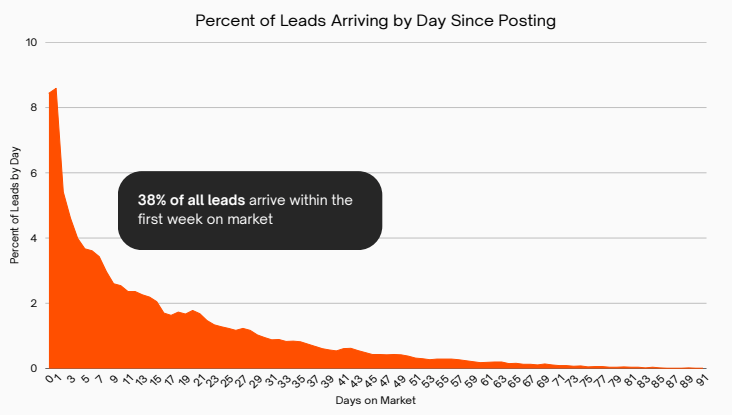
The chart below from the report is instructive. Tenants aren’t idiots. They know that if Zillow says a property has been on the market for 40 days that something is undesirable about it, so they move on to other listings that are newer. The vast majority of leads that you’re going to get on any given listing are coming in within the first month, and over a third are coming in within the first week. Setting the price wrong when the listing first gets marketed is killing you. So if you’re saying “we’ll let the owner experiment with this high price for two weeks, then drop it,” then you’ve already lost most of your opportunity. Setting the price right from the beginning is imperative.
But this isn’t just about price. This is also making us rethink the quality of our photos. Right now we get the property listed ASAP maybe some less desirable shots, then the better photos are posted a few days later. We might actually be better off to hold the property off market, even though it’s ready, until we get the best pics to attract the best residents. That way we’re hitting the market with solid marketing at the very beginning when the surge of leads will come in. I’m still contemplating this, so no firm decisions yet, but I’m leaning that direction based on this data.
Forget Your Schedule; It’s About the Renter’s Schedule
I know I beat this drum nonstop, but those of you still clinging to in-person showings are just doing leasing wrong. It’s PM malpractice at this point. Ten, even five years ago, maybe I could understand a hesitancy on self-showings, but now? You are just being negligent with your client’s asset at this point.
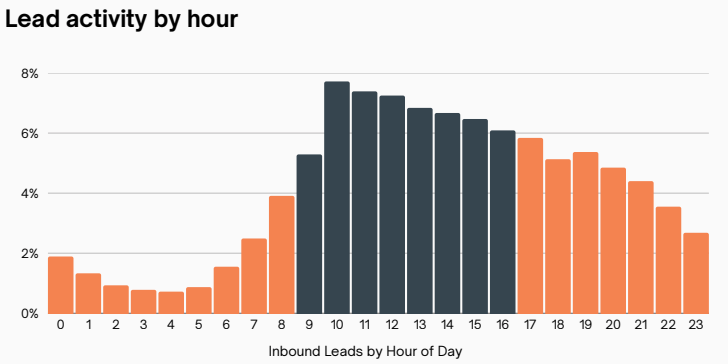
Residents are not browsing properties on Zillow at 2pm on a Tuesday and then going out to do a tour the next day at 11am when you have an opening on your calendar. They are browsing Zillow at 11pm while they’re in bed after a hard day at work, and they want to knock out a tour tomorrow at 6:30pm when they leave the office.
This isn’t just my suppositions, this is in the data. According to RentEngine’s data, nearly 60% of leads came in after business hours. And the most popular time for showings is 11am on a Saturday.
You basically have two options here:
Operate 24/7/365 with your leasing team.
Go to self-showings (we offer this as part of our package using ShowMojo).
Option 1 is wildly unrealistic for all but the most giant of operators. And option 2 is basically something you can do on autopilot. If this is a hard decision for you, then you aren’t being rational, you’re being stubborn. Stop it!
Good Leads Are Quiet Leads
My favorite thing about geeking out on data isn’t when it confirms my assumptions, but when it challenges them. This is one of those cases. You would think intuitively that the leads most likely to convert are the leads who are the most active, the ones reaching out with loads of questions and wanting to find out everything they can. But it turns out that the exact opposite is true. The leads most likely to apply and convert are the ones acting like introverts and quietly doing their own research.
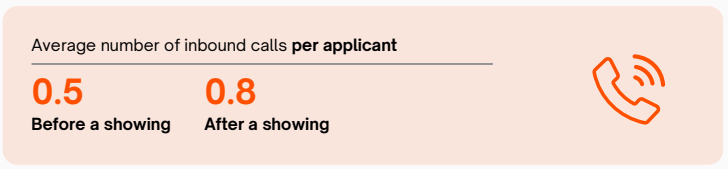
When looking at the leads who actually ended up moving in, RentEngine found that only 26% of them actually call before viewing the property. Three-quarters of converting leads are literally not talking to you. And this number seems even more stark when you consider that some portion of this dataset isn’t even doing self-showings, so the 26% of leads calling to schedule are frequently doing so because they have to.
It makes sense when you think about it. People who have tons of questions are frequently just window shoppers. They want to kick the tires, not make the purchase. When I walk onto a car dealership lot (possibly my least favorite thing to do on earth), I already know what exact car I want, what I’m going to offer for it, and what my bottom line is. I might test drive it, but I probably won’t even do that. I’ll just make the offer, tell them not to bother with the “let me talk to my manager” BS unless they want me to get up and leave, and quickly hammer out the deal. That’s what people who are actually ready to buy (or rent) do.
What this means for you from an operational standpoint is that you need to present as much information as possible online. They aren’t going to call you, so you want to make sure that everything they need to make a decision is easily at their fingertips. Yes, that means self-showings, but it also means that your application criteria need to be published, that your fee structure is transparent, etc. Anything that creates a bottleneck where someone has to talk to you is a mistake. The best leads don’t want to talk to you. That may bruise your ego, and challenge your archaic views on in-person showings, but the data is just the data. Deal with it.
Industry Best Practices
Love this section of the report, and not just because it basically proves all of the stuff that I’m constantly preaching from this publication. I love it because it’s putting hard data to a lot of the stuff that has slowly been becoming “industry standard” over the past few years.
First, my pet issue (pun intended, groan if you must): you’re an idiot if you’re not allowing pets in your properties. Yeah, that may sound harsh, but it’s intended to so that you’ll wake the hell up. RentEngine found that 87.7% of properties now allow pets. Do you think it might be negatively impacting your DOM if you are in the 12.3% of troglodytes still clinging to this outdated notion of pets being a problem in rental properties? Remember, as we’ve discussed previously, around 60% of renters have at least one pet, and the average tenant with a pet has more than two of them. If 87.7% of your competition is allowing pets, and you’re not, while the majority of the renter population has them, guess what that’s doing to you and your owner clients? If you need one final stat to make you come to your senses, other industry data shows that pet-friendly units consistently outperform on lead volume. That should be just assumed based on the above stats, but if you needed more concrete data, there it is.¹
Second, RBPs are no longer just nice little added programs to boost ancillary revenue. They’re now just expected. RentEngine found that a majority of all rentals now have an RBP, with an average monthly fee of $39.22/mo. You should have been doing this 5 years ago, but if you’re still not doing it, now is the time. Make this your Q1 project. Don’t let the quarter end without an RBP in place.
Third, your application criteria might be killing you. RentEngine found that the average credit score of approved applicants in Q3 was only 566. I know a lot of PMs who immediately deny anyone under 600, or even 650. I’ve long advocated for stringent screening, but I’ve never been a fan of credit scores. We look at the history – and sometimes the score is not a logical result of the history (maybe there is limited credit experience for instance). We need to be sensible, but consistent with our processing and using our heads instead of some “number” to determine the worthiness of any one applicant. Furthermore, it’s not just about credit. The average income multiple was only 2.6x the monthly rent. A whole lot of PMs are out there with a 3x floor with no exceptions. In our conventional wisdom, we are seeing a reasonable multiplier between 2.5 and 3x rent after doing a simple debt:income ratio.
Finally, cross-promoting listings seems to be a lot more important than I ever thought it was. RentEngine found that over 20% of leads are considering multiple properties from the same management company, with an average of 2.7 listings per lead being considered under the same PM. This means that there a big opportunity to lease units more quickly if you make the effort to promote similar listings to those leads coming in, which is precisely what we do. While some leads are going to make the effort to look at your other listings on your website, many aren’t even looking at your website at all, because they’re focusing on Zillow. This is why we take intiative to make interested parties aware of similarly situated homes currently on the market or coming soon.
Final Thoughts
A few years ago these nuances might not have been all that important. When the average DOM is only 15, and a “long” marketing time is three weeks, tweaking these things probably isn’t going to make all that big of a difference. But when the average DOM is pushing a full month, we need to do all we can to reduce that timeline.